Avenue Decor
Minimalist interiors leave little room for visual noise. Smooth cabinet fronts, pale walls, and clear sightlines make every surface more noticeable. Why choose PET faced boards for modern minimalist interiors? Their clean appearance, practical surface, and range of understated colors can support a calm design without demanding attention. The finish may look simple, but its everyday performance matters.
PET-faced boards are commonly used for cabinetry, wardrobes, and wall panels. Their surface is generally easy to wipe with a soft cloth and mild cleaner, though care instructions vary by product. Check the manufacturer’s guidance before choosing cleaning products. Small details matter. Matte finishes can soften glare, while a subtle sheen may brighten a shaded kitchen. Color samples should be viewed in the actual room, because daylight and warm LEDs can shift how a neutral tone appears. Ask about the board’s core, edge treatment, and recommended installation conditions, too. A refined face cannot compensate for poorly sealed edges or unsuitable detailing.
These boards are not a perfect answer for every project. Scratches, heat, moisture, and installation quality can affect long-term results, and the exact resistance depends on the product. That deserves a closer look. Comparing technical information with real samples helps designers and homeowners make a more informed choice. This guide explores the aesthetic benefits, practical considerations, and selection questions that can help determine whether PET-faced boards suit a modern minimalist interior.
What Are PET-Faced Boards?
A PET-faced board is an engineered panel with a decorative surface made from PET, or polyethylene terephthalate. The core is commonly MDF or particleboard. A thin PET film is bonded or laminated to one or both faces, creating a smooth, consistent finish. It is not a solid-plastic slab. The substrate provides most of the board’s thickness and structure; the surface provides its appearance and everyday touch.
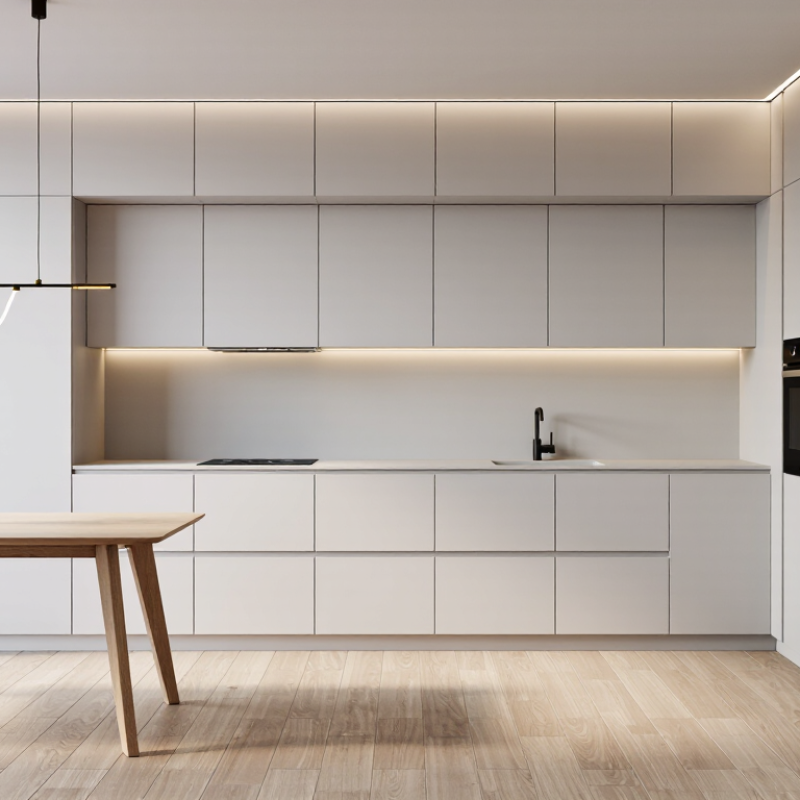
In a minimalist kitchen, that surface might appear as a quiet matte cabinet door, with clean edges and little visible grain. PET finishes also come in gloss and varied colors. Their look and feel depend on the film, bonding process, and production quality. Ask about edge sealing and cleaning guidance, especially near sinks. Moisture resistance is not the same as waterproofing.
Material claims need context. The OECD’s 2022 Global Plastics Outlook estimates that 353 million tonnes of plastic waste were generated worldwide in 2019, and only 9% was recycled. That is a broad plastics figure, not a recycling rate for PET-faced boards. It is still a useful reminder to check the panel’s composition, durability, and local end-of-life options rather than assuming a plastic surface is automatically sustainable.
Minimalist interiors depend on calm surfaces, clear lines, and a limited palette. PET-faced boards support this look with a smooth, even finish and colors that range from soft white to muted stone and wood tones. Their low visual texture helps cabinets sit quietly against a wall rather than compete with the room. That matters in a small kitchen, where glossy fronts can catch a window’s reflection and make the space feel busier. Matte finishes are gentler on the eye. They may still show fingerprints in strong side light, though.
PET surfaces are commonly chosen for their consistent appearance and straightforward cleaning. A soft cloth and mild detergent usually handle everyday marks; abrasive pads can dull the finish. Check the sample under both daylight and warm evening lighting, since a gray panel can look surprisingly blue at night. Also inspect edges and corners, not just the large face. The finish cannot hide poor alignment or rough detailing.
A restrained color scheme can feel a little too flat, so a contrasting countertop, visible wood grain, or subtle change in texture can add depth without disrupting the minimalist mood. Even then, restraint takes judgment.
PET-faced boards provide a clean, even surface that suits the uncluttered look of minimalist interiors. Their finish is available in subtle colors and textures, so cabinets and wall panels can feel calm without looking entirely flat. Under kitchen lighting, a matte surface can also soften glare. Small detail, noticeable effect.
For daily care, most marks from fingerprints or light spills can be wiped away with a soft cloth and mild cleaner. That makes PET-faced panels practical for wardrobe doors, kitchen fronts, and bathroom storage away from direct water exposure. The surface is generally resistant to everyday stains and wear, though performance varies by product. No surface is invincible. Abrasive pads or harsh solvents may dull the finish, so gentle cleaning matters.
The boards also help create a consistent appearance across multiple cabinet doors, where uneven color can distract from a simple design. Their smooth faces are easy to inspect and maintain, but the edges deserve attention. Poorly sealed edges can allow moisture to affect the substrate, especially near sinks. Check the product specifications and installation guidance before choosing a board for humid rooms. A well-finished edge makes a real difference.
PET-faced boards work well on kitchen cabinet doors, drawer fronts, wardrobes, bathroom storage, and built-in shelving. Their smooth, low-gloss surfaces suit minimalist rooms, where uninterrupted planes and neat gaps matter. Houzz’s 2024 U.S. Kitchen Trends Study reports that 76% of renovating homeowners upgraded their cabinets, making cabinet fronts a practical application.
In kitchens, choose a board core and edge treatment suited to the expected moisture and cleaning conditions. A durable face does not make every board waterproof. Edges matter.
In bedrooms, PET-faced boards can form wardrobe doors, desk surfaces, and open-shelf back panels. In offices or retail spaces, they can cover storage units and reception cabinetry, where fingerprints and frequent wiping are everyday concerns.
The U.S. Environmental Protection Agency notes that people spend about 90% of their time indoors; that is a useful reminder to consider indoor materials carefully, not proof that one finish improves air quality. Ask suppliers for emissions and care information, and test a sample under the room’s actual lighting. Pale surfaces can show marks. Dark ones can show dust. PET is not automatically the right choice for every wall or high-heat location, and the core, adhesive, and installation details deserve equal attention.
When choosing PET-faced boards, match the surface to the room’s actual use. A matte finish can soften glare in a small kitchen, while pale colors may reveal scuffs near handles. Check the board’s substrate, thickness, and flatness; a smooth face cannot hide a warped core. Ask for abrasion, scratch, stain, and heat-test results, not just attractive sample photos. Look closely at corners and cut edges. Weak edge sealing can let moisture reach the core.
Indoor emissions deserve equal attention. UL Environment’s published GREENGUARD Gold criteria set limits of 220 µg/m³ for total VOCs and 9 µg/m³ for formaldehyde. These are chamber-test thresholds, not promises about concentrations in every finished room. Request current test documentation for the exact board and adhesive combination. Also compare color consistency across batches, cleaning instructions, and repair options. PET can be durable, but deep damage may be difficult to blend in. That detail is easy to overlook. For minimalist interiors, small differences in sheen and edge alignment become unusually visible; inspect full-size samples under the room’s lighting before ordering.
| Factor | What to Evaluate | Why It Matters in a Minimalist Interior | Practical Selection Check |
|---|---|---|---|
| Surface appearance | Color consistency, texture, gloss level, and how the finish looks under the room’s lighting. | Simple schemes make large, uninterrupted surfaces visually prominent; reflections and color shifts can be noticeable. | Review a large sample in the intended room and compare it in both daylight and artificial light. |
| Substrate and board thickness | Identify the core material, panel thickness, flatness, and suitability for the intended application. | The PET layer is a surface finish; the substrate contributes much of the panel’s stiffness and structural performance. | Match the panel specification to the cabinet, wall, or furniture design, and confirm support and fixing requirements. |
| Edges and fabrication | Check edge-banding compatibility, corner details, cut quality, and the fabricator’s recommended processing method. | Clean, consistent edges help maintain the neat lines associated with minimalist cabinetry and built-ins. | Ask to inspect a finished sample corner or door rather than assessing only a flat board sample. |
| Cleaning and everyday use | Obtain the maker’s care instructions and confirm which cleaners and cloths are suitable for the surface. | Kitchen and bathroom cabinetry may encounter fingerprints, splashes, and frequent wiping. | Choose a finish and color that suit the expected use, and follow the specified cleaning guidance. |
| Scratch, heat, and chemical resistance | Compare documented test results and limitations for the exact surface and board construction. | Performance can vary by product; a PET-faced surface should not automatically be treated as scratch-proof or heat-proof. | Request technical data for the intended use, and use trivets or protective pads where appropriate. |
| Moisture exposure | Check the moisture suitability of the substrate, the edge treatment, and the installation environment. | A surface film does not make every board waterproof; exposed or poorly protected edges can be vulnerable to moisture. | For areas exposed to humidity or splashes, confirm the full panel specification and seal cut edges as directed. |
| Indoor air quality | Review emissions documentation for the board substrate and any applicable regional standards or certifications. | The substrate and adhesives can affect indoor emissions; the PET facing alone does not establish the panel’s emissions performance. | Request current documentation for the complete panel, not just information about its decorative surface. |
| Repair and replacement | Consider whether damaged panels can be repaired, replaced, or matched later. | Large, coordinated surfaces can be difficult to blend if a panel is damaged or a finish is discontinued. | Keep spare material where practical and record the finish, batch, and panel specifications. |
| Cost and whole-project value | Compare panel price alongside fabrication, edge finishing, installation, maintenance, and expected service needs. | The lowest board price may not reflect the total cost of achieving a consistent, finished installation. | Compare like-for-like specifications and obtain quotations that include processing and installation details. |
Selection note: PET-faced boards combine a PET surface layer with a separate substrate. Performance depends on the complete panel, its edge treatment, fabrication, and installation. Confirm product-specific technical data before specifying a board for a particular application.
It is an engineered panel, usually with an MDF or particleboard core. A thin PET film covers one or both faces. The core provides structure; the surface provides the visible finish.
No. The plastic film is only the surface layer, not the full-thickness panel. Check the product details to confirm its core and construction.
Smooth surfaces and restrained colors can help cabinets look calm and uncluttered. Matte finishes feel gentle, while gloss can reflect a nearby window. Strong side light may reveal fingerprints.
They are often used for kitchen cabinet doors, drawer fronts, wardrobes, bathroom storage, and built-in shelving. They can also cover office storage or reception cabinets. Choose the core for the room’s conditions.
No. Moisture resistance does not mean waterproofing. Check edge sealing and installation details, especially around sinks. Edges matter.
A soft cloth and mild detergent usually handle everyday marks. Avoid abrasive pads, which can dull the finish. Simple care, mostly.
View a sample in daylight and warm evening light. A gray panel may look blue at night. Check corners and edges too, not just the large face.
No. Global plastic-waste figures do not show the recycling rate of these panels. Ask about their composition, durability, and local end-of-life options. I would not assume the surface settles the question.
Request emissions and care information from the supplier. The core, adhesive, and installation details matter too. A surface finish alone does not prove better indoor air quality.
Why choose PET faced boards for modern minimalist interiors? These boards pair a smooth, consistent surface with the clean lines and uncluttered look that define minimalist spaces. A PET finish can bring subtle color, gentle sheen, or a refined matte effect to cabinetry and wall panels without overwhelming the room. The result is a cohesive appearance that works well with simple forms, restrained palettes, and varied natural materials.
Beyond appearance, PET-faced boards are valued for their easy-to-clean surfaces and everyday practicality, making them suitable for kitchens, wardrobes, storage units, and selected feature walls. When choosing them, consider the color and finish, board thickness, edge treatment, intended use, and compatibility with the surrounding design. Checking product specifications and care requirements also helps ensure the boards suit the room’s needs and maintain a consistent, polished finish over time.
