Avenue Decor
How to waterproof MDF for bathroom vanity use? The question sounds simple, but MDF is not naturally waterproof. Moisture can enter through exposed edges, sink cutouts, screw holes, and unsealed joints. In humid Chinese cities, repeated hot showers and poor ventilation can make small defects visible within months.
The USDA Forest Products Laboratory’s Wood Handbook explains, “Wood is hygroscopic; it gains and loses moisture as surrounding conditions change.” This principle also matters for MDF, because its wood fibers swell when moisture reaches the core. The ANSI A208.2 standard distinguishes moisture-resistant MDF from ordinary MDF, but neither grade should be treated as permanently waterproof. That difference is important.
EPA’s Moisture Control Guidance recommends controlling indoor humidity and preventing standing water around building materials. For a bathroom vanity, practical protection includes sealing every cut edge, applying polyurethane or two-part epoxy around the basin opening, and covering surfaces with compact laminate, HPL, or sealed veneer. The underside deserves attention. Water often collects there unnoticed.
As bathroom-furniture specialist Li Wei explains, “The weakest waterproofing detail is usually the edge, not the large flat panel.” His observation reflects workshop experience, especially with vanity units assembled from CNC-cut MDF. A perfect seal is not a realistic promise. Regular inspection still matters.
This guide explains how to waterproof MDF for bathroom vanity use, from panel selection and edge preparation to coating thickness, installation clearance, ventilation, and maintenance. It also examines common failures, including swollen toe-kicks, loose fasteners, and cracked sealant. Small details decide the service life. Not the marketing label.
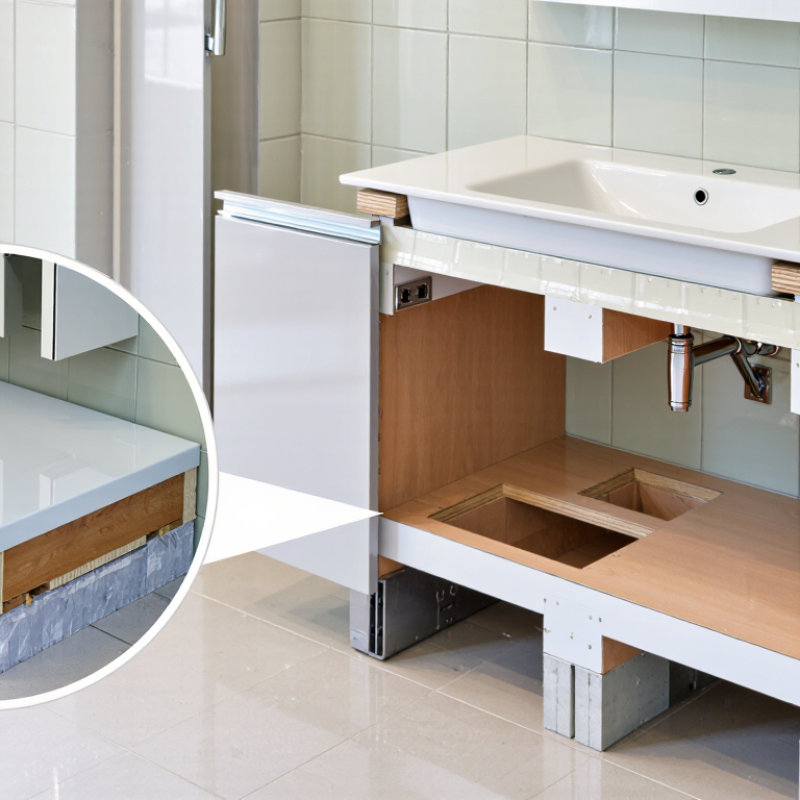
Moisture-resistant MDF can work for a bathroom vanity in China, but it is not waterproof. Start with panels rated as MR MDF under GB/T 11718. Ask the supplier for the product grade, test report, and production batch information. Do not rely on the phrase “water-resistant” alone.
The key check is 24-hour thickness swelling. A qualified laboratory immerses a prepared sample and measures how much its thickness increases. Request the actual result, not only a pass statement. Compare it with the required value under the applicable grade. Low swelling suggests better stability, but it cannot protect an unsealed cabinet edge. I have seen small swelling begin around sink cutouts after repeated splashes. That detail is easy to miss.
Tips: Seal every cut edge before assembly. Use suitable bathroom-grade coating on both faces, especially around hinges and plumbing holes. Keep the cabinet base above standing water, and leave access for leak inspection. Confirm the sealant bonds well to the MDF surface. Test a coated offcut first. A perfect-looking finish may still fail at a screw hole. During installation, protect panel joints from trapped moisture, and repair damaged coating promptly. In humid southern areas, ventilation matters as much as panel selection. Even a strong board can deteriorate when water remains under the vanity. Supplier documents should be checked against the delivered batch, because specifications and real products do not always match.
How to Waterproof MDF for Bathroom Vanity Use in China?
A Chinese bathroom vanity should be designed for 20–30°C and 60–90% relative humidity. These are demanding conditions, especially during summer showers. China Meteorological Administration climate summaries show that many southern and coastal cities experience prolonged humid periods, not just short moisture peaks. A vanity beside a shower can face condensation, wet hands, floor cleaning, and repeated splash exposure. The weakest points are usually sink cutouts, screw holes, bottom edges, and rear ventilation gaps.
The USDA Wood Handbook, Chapter 12, explains that wood-based panels exchange moisture with surrounding air. At about 20°C and 60% relative humidity, wood commonly approaches roughly 11% equilibrium moisture content. Near 90% relative humidity, that value can approach 20%, depending on temperature and panel composition. MDF may swell faster at exposed edges. Moisture-resistant MDF is not waterproof. That distinction matters.
I would seal every face, edge, and machining cut with a continuous coating system. Two-component polyurethane or equivalent moisture-resistant coatings can improve resistance, but surface preparation remains critical. Sealant should surround plumbing penetrations, not merely cover visible gaps. Keep the bottom panel at least slightly above wet flooring, and provide airflow behind the cabinet. Test samples through repeated 20–30°C and 60–90% humidity cycles. Measure edge swelling and screw-holding strength afterward. A single dry-room test is weak evidence. My practical mistake would be trusting the coated front surface while ignoring the raw underside. That failure is common.
| Representative China Bathroom Condition | Air Temperature | Relative Humidity | Approximate Dew Point | Typical Moisture Load | High-Risk Vanity Areas | Recommended MDF Protection | Inspection or Acceptance Focus |
|---|---|---|---|---|---|---|---|
| Dry northern winter bathroom Heated interior with short, high-humidity periods after bathing |
20–24°C | 60–75% | 12–19°C | Intermittent shower steam, splash water, and condensation on cold plumbing or wall surfaces | Sink cut-outs, bottom edges, rear corners, pipe penetrations, and areas below the trap | Seal all cut edges; apply a continuous water-resistant coating; use sealed joints and a moisture-resistant countertop interface | No exposed fiber, open pinholes, unsealed screw holes, or visible coating discontinuity |
| Warm central or eastern apartment bathroom Regular daily bathing with moderate ventilation |
22–28°C | 65–80% | 15–24°C | Repeated vapor exposure, occasional splash, wet cleaning, and elevated humidity for 1–3 hours per day | Door edges, drawer fronts, floor-facing panels, basin opening, and hardware holes | Use low-swelling MDF where available; seal six sides, especially machined edges; add a raised plinth or waterproof legs | Check coating adhesion, edge coverage, joint sealing, and clearance from standing water |
| Humid southern inland bathroom High ambient humidity during warm and rainy seasons |
24–30°C | 75–90% | 19–28°C | Long-duration humidity, slow drying after cleaning, condensation risk, and possible moisture migration from walls | All exposed edges, underside, wall-side back panel, plinth, and joints close to the floor | Prefer a fully encapsulating coating system; seal end grain and fastener holes; isolate the cabinet from wet walls and floor | Confirm uniform film thickness, sealed perimeter joints, dry cabinet base, and adequate exhaust ventilation |
| Coastal or island bathroom Warm, humid air with salt-laden moisture possible |
25–30°C | 80–90% | 21–28°C | Persistent humidity, frequent condensation, splash water, and accelerated corrosion of poorly protected hardware | Bottom corners, concealed rear surfaces, metal fixings, hinge cups, and exposed coating scratches | Use a closed, continuous finish; protect drilled holes; select corrosion-resistant hardware; avoid direct wall contact | Inspect for blistering, edge swelling, rust staining, coating damage, and trapped moisture behind the cabinet |
| Small bathroom with limited ventilation High humidity remains after showering |
22–28°C | 80–90% | 19–26°C | Repeated vapor cycles with limited drying; higher chance of condensation and prolonged surface wetness | Back panel, wall-side edges, cabinet interior, drawer runners, and underside of the basin | Use sealed backs and interiors; provide ventilation gaps; use waterproof silicone at fixed joints without blocking drainage | Verify that doors and drawers do not trap moisture and that the cabinet dries within a reasonable maintenance cycle |
| Direct splash zone near the basin Water can contact the vanity during normal use |
20–30°C | 60–90% | 12–28°C | Direct droplets, wet hands, overflowing basin water, and repeated wiping with damp cloths | Basin cut-out, top edges, drawer fronts, side panels, and countertop-to-cabinet joint | Use a sealed countertop interface, flexible sanitary sealant, rounded or filled edges, and a topcoat resistant to repeated cleaning | Perform a localized water exposure check; look for absorption, edge darkening, swelling, or sealant separation |
| Floor-adjacent or mop-water zone Cabinet base may receive wet cleaning water |
20–30°C | 65–90% | 13–28°C | Splash-back, damp mopping, accidental leaks, and standing water at the cabinet base | Bottom edges, plinth, leg connections, toe-kick joints, and lower fastener holes | Keep MDF at least 50–100 mm above the finished floor where practical; use sealed feet, a removable plinth, and drainage paths | Confirm no MDF edge is exposed to standing water and that leaks can be detected and dried quickly |
| Occasional plumbing leak scenario Abnormal but credible water exposure |
20–30°C | 60–90% | 12–28°C | Localized continuous wetting from a loose connection, failed seal, blocked drain, or overflowing fixture | Cabinet floor, pipe cut-outs, rear corners, shelf supports, and joints beneath the trap | Add a removable leak tray where possible; seal penetrations; use accessible plumbing connections and avoid hidden MDF contact points | Check whether water can be identified, contained, drained, and dried without dismantling the entire vanity |
MDF can work for a bathroom vanity in China, but its exposed fibers need careful protection. Steam, splashed water, and wet cleaning cloths can enter tiny gaps. Sealing only the visible face is not enough.
Use a two-part polyurethane coating mixed exactly according to its technical sheet. Apply it to all six MDF sides: the front, back, top, bottom, and both side edges. Coat every basin opening, pipe hole, screw recess, and cut edge. These areas absorb moisture quickly.
Lightly sand swollen fibers after the first coat has cured, then apply another coat to the edges. Do not rush this step.
Keep the panels flat in a clean, ventilated workshop. Temperature and humidity can change during China’s rainy season, affecting curing and adhesion. Measure the components accurately, and avoid adding unapproved thinner. A small brush helps push coating into narrow cutouts.
A dry-film check is useful before assembly. Look for pinholes, dull patches, and exposed fibers under strong light. I once missed a rear edge because it was hidden during installation. That mistake showed me that inspection must happen before packing, not after mounting.
Seal the underside, too. It receives less attention but can still contact damp flooring or trapped condensation. PU coating improves moisture resistance; it does not make damaged MDF permanently waterproof.
MDF is not naturally waterproof, even when coated with paint or laminate. Bathroom vanities face splashes, damp air, and leaking pipe connections. Therefore, the 24-hour thickness swelling test under GB/T 17657 deserves attention before assembly.
Ask the supplier for a recent test report from the same MDF grade and production batch. The test measures how much a specimen expands after 24 hours of water exposure. Follow the current GB/T 17657 edition for sampling, conditioning, immersion, and measurement details. Do not judge performance from appearance alone. A smooth board can still swell badly at cut edges. A practical check includes the panel core, drilled holes, sink opening, and concealed bottom edge. Sealing these areas is essential, but sealing cannot repair weak raw material.
Tips: Compare the reported swelling value with your project specification. Keep the report, batch number, and delivery date together. Test a retained sample when possible. Leave enough clearance around plumbing joints, because trapped water creates repeated swelling. Edge sealing should be continuous, not just a quick brush along visible cuts. Small gaps matter.
A useful workshop habit is to inspect one assembled sample after several wet-dry cycles. It may reveal problems that laboratory data misses. This is not a replacement for GB/T 17657 testing. It is a reminder that installation quality affects real bathroom performance.
Bathroom vanity MDF faces two separate risks: moisture damage and formaldehyde exposure. Waterproofing cannot reduce formaldehyde emissions. China’s GB/T 39600 classifies E1 wood-based panels at no more than 0.124 mg/m³ under chamber testing. Request a test report showing the panel grade, thickness, production batch, and test method. A supplier’s general certificate is not enough.
The World Health Organization recommends keeping indoor formaldehyde below 0.1 mg/m³ over 30 minutes, according to its 2010 indoor air quality guidelines. China’s GB/T 18883-2022 sets a stricter indoor concentration reference of 0.08 mg/m³ for a one-hour average. These figures use different testing conditions, so they should not be compared casually. A cabinet panel meeting E1 does not guarantee the finished bathroom reaches either indoor-air limit.
For waterproofing, seal every cut edge before assembly. Use a suitable moisture-resistant coating, then add a durable topcoat around the sink opening, screw holes, and bottom edge. Keep MDF at least slightly above the wet floor. Ventilation matters. So does installation quality. A small unsealed edge can swell after repeated splashing. In my experience, the weak point is rarely the large panel surface. It is the hidden joint. Coatings also wear faster than expected, so inspect them annually. Waterproofing is not magic.
Yes, if designed carefully. MR MDF resists moisture better than standard MDF, but it is not waterproof.
Request the product grade, test report, and production batch information. Check the documents against the delivered panels.
It shows how much a sample expands after water immersion. Ask for the actual measured result, not only a pass statement.
Protect sink cutouts, screw holes, bottom edges, plumbing holes, and rear ventilation gaps. These areas often fail first.
Apply a continuous bathroom-grade coating to both faces, every edge, and each machining cut. Seal plumbing penetrations completely.
Yes. A screw hole or raw underside may absorb moisture unnoticed. I might overlook that during a rushed inspection.
Design for 20–30°C and 60–90% relative humidity. Summer showers can create repeated condensation and splash exposure.
Keep the cabinet base above wet flooring and provide airflow behind it. Leave access for leak inspection and repair damaged coating quickly.
Yes, test a coated offcut first. Repeat humidity cycles and inspect edge swelling, adhesion, and screw-holding strength.
Yes. Even strong panels can deteriorate when water remains underneath. Good ventilation matters as much as panel selection.
How to waterproof MDF for bathroom vanity use? Start by selecting moisture-resistant MDF that is rated according to China’s GB/T 11718 standard, and verify its 24-hour thickness swelling performance before production. The panel should be evaluated for the expected bathroom environment, including temperatures of approximately 20–30°C and relative humidity between 60% and 90%. This helps ensure that the material is suitable for daily exposure to moisture and changing indoor conditions.
Before assembly, test the MDF again under GB/T 17657 to confirm its 24-hour thickness swelling meets the project requirement. Every surface must be protected, including all six panel sides, edges, drilled holes, joints, and other cutouts. Apply a continuous two-part polyurethane coating to prevent water from entering vulnerable areas. Finally, confirm that the finished product meets China’s E1 formaldehyde limit of no more than 0.124 mg/m³ under GB/T 39600, supporting both durability and indoor air quality.
