 Avenue Decor
How much weight can a standard particle board shelf hold? The honest answer depends on more than the shelf’s material. Thickness, width, support spacing, edge quality, and installation method all affect its safe capacity. A narrow, well-supported shelf may carry books comfortably, while a long, unsupported panel can bend under a much smaller load.
In practical furniture work, particle board shelves often perform best when weight is distributed evenly. A row of lightweight storage boxes creates less stress than one dense stack of textbooks. Moisture also matters. Damp particle board can swell, soften, and lose strength around screws. Check the panel for sagging, chipped edges, loose fasteners, or visible swelling before adding more weight. Small details matter.
There is no universal rating.
Manufacturers may provide load tables, but those figures usually assume specific shelf dimensions and support conditions. Without that information, any single number is only an estimate. A careful evaluation should measure the shelf thickness, span, depth, and support locations. It should also consider whether the brackets are secured into studs or suitable wall anchors.
For a reliable decision, begin with the manufacturer’s specifications whenever possible. If those are unavailable, use a conservative load and test gradually. Place heavier items near the supports, not at the center. Watch for deflection over several hours, because particle board may deform slowly. I would not treat a shelf that “looks fine” as proven safe. That assumption is easy to make, and sometimes wrong. This guide explains the main factors behind shelf capacity and offers practical ways to reduce failure risks.
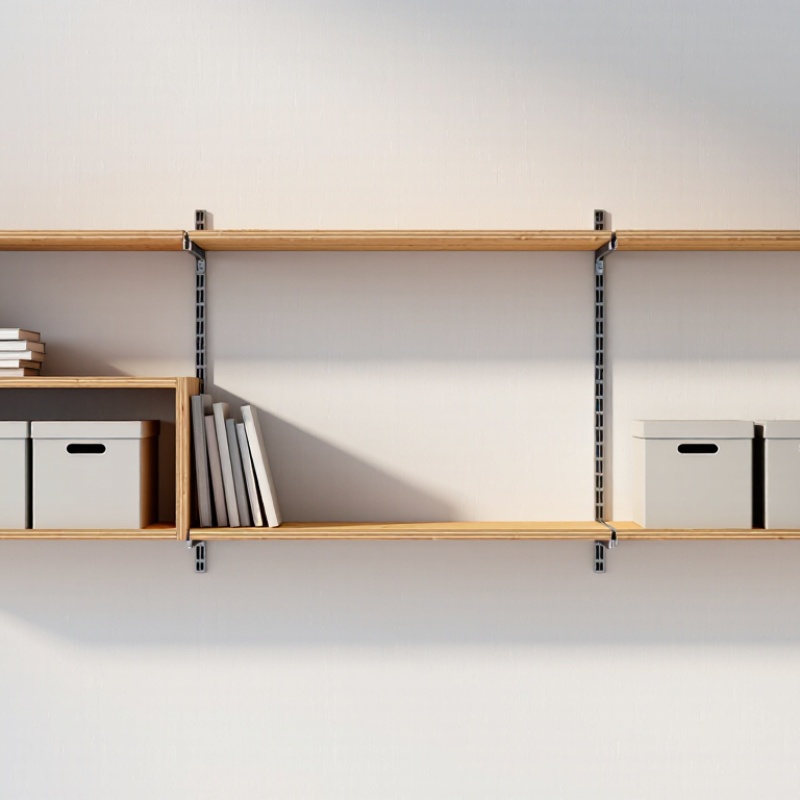
Standard particle board is an engineered wood panel made from small wood chips, sawdust, and resin. Manufacturers dry and screen these particles before arranging them into layers. Larger pieces usually form the core, while finer particles create smoother outer surfaces. Heat and pressure then bond the mixture into a rigid sheet.
The word “standard” can be misleading. Thickness, density, moisture resistance, and panel size vary by supplier and region. A typical shelf may look solid, yet its capacity depends on span, support spacing, edge strength, and load distribution. In my workshop, a long shelf began sagging under books before it showed any visible damage. I had underestimated the span. That mistake still influences how I install shelving.
Tips: Check the panel thickness and support spacing before loading it. Keep heavy objects near the brackets or side panels. Use a straightedge to watch for gradual sagging. Avoid placing particle board in damp areas, because swelling can weaken its edges. A test load should increase slowly, not all at once. Fasteners also matter; screws near damaged edges may loosen unexpectedly. For a precise capacity, follow the panel supplier’s tested load data rather than relying on a general estimate. There is no single safe weight for every “standard” shelf.
| Category | Typical Standard | Practical Information | Effect on Shelf Capacity |
|---|---|---|---|
| Material definition | Wood particle panel | A manufactured panel made from wood particles, chips, or flakes bonded with a resin adhesive and compressed under heat and pressure. | It is structurally useful but generally less resistant to moisture and screw pull-out than solid wood or plywood. |
| Common thicknesses | 12, 15, 18, and 25 mm (approximately 1/2, 5/8, 3/4, and 1 in) |
Shelf boards are commonly produced in thicknesses from about 12 to 25 mm, depending on the intended use. | Increasing thickness significantly reduces bending and usually increases the safe working load. |
| Typical density | Approximately 600–750 kg/m³ | Density varies with the panel grade, particle size, moisture content, and manufacturing process. | Higher-density panels are usually stiffer and stronger, but density alone does not determine the complete shelf rating. |
| Manufacturing process | Particle preparation → drying → adhesive blending → mat forming → hot pressing → finishing | Wood particles are dried, mixed with resin, arranged into a mat, pressed into a panel, cooled, trimmed, and often laminated or veneered. | Uniform pressing and consistent density improve dimensional stability and load performance. |
| Reference shelf setup | 18 mm panel, 300 mm deep, 600 mm unsupported span | The estimates below assume a dry indoor environment, evenly distributed weight, and support along both ends. | Actual capacity changes substantially when the span, depth, support method, or load distribution changes. |
| Estimated uniformly distributed load | Approximately 20–30 kg (44–66 lb) |
A practical working range for an 18 mm shelf with the reference setup, allowing for visible deflection and normal household use. | Use the lower end when the panel is low-density, the supports are weak, or the load may be concentrated. |
| 12 mm shelf, 600 mm span | Approximately 10–15 kg (22–33 lb) |
Suitable for lighter items when the shelf is properly supported at both ends and kept dry. | The thinner panel is more likely to sag, particularly when books or other dense objects are stored across the center. |
| 25 mm shelf, 600 mm span | Approximately 35–50 kg (77–110 lb) |
A thicker panel provides substantially better stiffness for books, storage containers, and other evenly distributed household loads. | The supporting brackets, pins, fasteners, and wall structure may become the limiting factors. |
| Effect of unsupported span | Longer span = lower capacity | A shelf spanning 900 mm generally deflects much more than the same shelf spanning 600 mm under the same load. | Adding a center bracket or divider is often more effective than simply increasing the load rating of the fasteners. |
| Moisture limitation | Keep standard interior-grade panels dry | Unsealed particle board can swell when exposed to water or persistently high humidity, especially at cut edges. | Swelling can permanently reduce stiffness, weaken fastener connections, and make the original load estimate unreliable. |
| Best practice for loading | Distribute weight evenly | Place heavy items near supports, avoid point loads, seal exposed edges, and inspect for sagging or damaged fasteners. | For heavy storage, use a center support, a front edge stiffener, or a thicker engineered panel rather than relying on a long unsupported span. |
Note: The load ranges are practical estimates, not universal certified ratings. The final safe capacity depends on panel grade, thickness, span, shelf depth, support spacing, fasteners, wall construction, moisture, and whether the load is uniformly distributed or concentrated.
It uses wood chips, sawdust, and resin. Manufacturers dry and screen these particles. Larger pieces usually form the core. Finer particles create smoother surfaces. Heat and pressure bond everything into a rigid panel.
No. Thickness, density, moisture resistance, and panel size can vary. A shelf may look solid but still have limited capacity. Always check the supplier’s panel details before installation.
Thickness, span, depth, density, and support spacing all matter. Moisture and edge condition also affect performance. A short shelf with close supports usually performs better. There is no universal safe weight.
A 12 mm shelf across 600 mm may hold roughly 5–8 kg evenly distributed. An 18 mm shelf may handle about 10–15 kg across the same span. A 25 mm shelf may support approximately 20–30 kg with reliable edge support. These are cautious estimates, not guaranteed limits.
A 36-inch shelf supported only at both ends bends more easily. A shorter 24-inch shelf usually resists sagging better. A center bracket can reduce deflection sharply. Long spans create greater stress in the middle.
Keep heavy objects near brackets or side panels. Spread books across the surface instead of creating one central stack. Avoid concentrating weight at the middle. Small changes help.
Yes. Damp panels can swell and lose stiffness. Their edges may become soft or crumbly. Screws may loosen in swollen material. Avoid damp rooms unless the panel has suitable protection.
Use a straightedge to inspect gradual sagging. Press lightly and watch for unusual flexing. Check screw holes for cracks or crushed edges. Increase a test load slowly, not all at once. If the shelf bends, remove weight immediately.
Not always. A thicker panel helps, but shorter spans often help more. Better support spacing can matter more than extra thickness. My own shelf sagged because I underestimated its span. A neat calculation is not a guarantee.
How much weight can a standard particle board shelf hold? The answer depends on more than the material alone. Standard particle board is made by compressing wood particles and adhesive under heat and pressure, creating an affordable, uniform panel. Its load capacity is affected by shelf thickness, width, depth, support spacing, mounting method, moisture exposure, and whether the weight is evenly distributed. Thicker shelves with shorter spans generally support more weight, while thin, wide shelves are more likely to bend or sag.
To calculate a safe load, consider the shelf’s weakest point and use a conservative estimate rather than its maximum breaking strength. Place heavier items near the supports, avoid concentrated loads, and inspect the shelf regularly for bending, cracks, or swelling. Adding a center bracket, reducing the unsupported span, attaching a solid edging strip, or replacing a thin panel with a thicker one can significantly improve stability. Proper installation and balanced loading are essential for preventing failure over time.
