Avenue Decor
China’s WPC panel industry offers many options for commercial interiors, façades, partitions, and ceiling systems. This guide examines ten leading fire-resistant WPC panels made for demanding commercial environments. The evaluation considers fire ratings, surface durability, moisture resistance, installation methods, and manufacturer transparency.
Performance varies widely. A panel may resist ignition briefly but still produce smoke or fail under prolonged heat. Are WPC panels fire-resistant for commercial building codes? The answer depends on the product formulation, tested assembly, thickness, installation system, and local regulations. Buyers should request current test reports from recognized laboratories, not rely only on sales claims. Important evidence may include reaction-to-fire classification, smoke data, flame spread results, and full-system testing.
Real project experience also matters. A corridor panel beside a busy elevator lobby faces different risks than a decorative office wall. Heavy traffic can cause scratches, while concealed wiring may increase installation concerns. This article compares Chinese suppliers through documented performance, production consistency, technical support, and commercial references. It also considers whether each panel suits hotels, offices, retail spaces, healthcare facilities, or public buildings.
A strong product is not automatically suitable everywhere. Local approval remains essential. Some evidence remains incomplete, especially when suppliers publish limited laboratory details. That weakness deserves attention. Readers should verify certificates, batch consistency, edge treatment, adhesives, and installer qualifications before specifying a panel. The following list aims to support practical decisions, while recognizing that fire safety requires professional review and project-specific compliance.
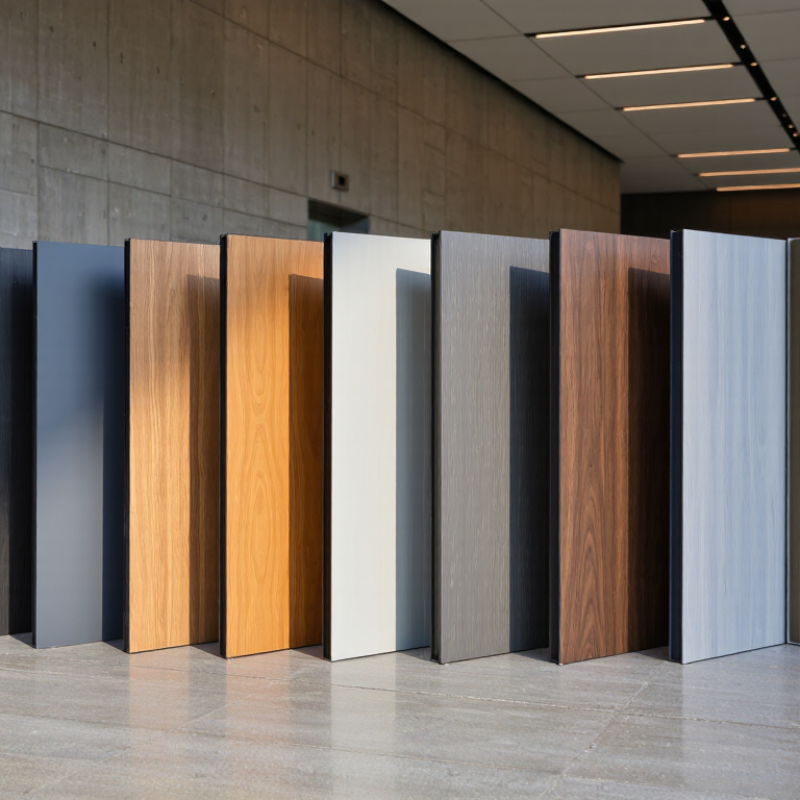
China’s fire-resistant WPC panel market serves offices, hotels, retail interiors, transport areas, and public buildings. A “top ten” list should not rank appearance alone. It should compare tested fire performance, documentation, durability, and installation control.
In China, buyers commonly review GB 8624 fire-reaction classifications alongside project-specific design codes. Test reports should identify the exact panel structure, thickness, surface finish, and mounting method. A certificate for one assembly may not cover another. This detail is often missed.
Scope matters. Interior wall panels, ceiling systems, partitions, and exterior cladding face different exposure conditions. Moisture, heat, impact, smoke, and maintenance can change the practical result. On commercial fit-outs, I would request batch traceability, laboratory reports, installation instructions, and evidence from similar applications. Ask about flame spread and smoke behavior, not only the phrase “fire resistant.”
Selection should begin with the building’s occupancy, escape routes, substrate, and required fire rating. Then compare density, recycled content, dimensional stability, color retention, and cutting behavior. A panel that performs well in a laboratory may fail after careless joints, hidden voids, or unapproved adhesives. That is uncomfortable, but important. Independent review remains necessary when documents conflict or appear incomplete.
Choosing the top 10 fire-resistant WPC panels for commercial use requires more than comparing flame-retardant claims. NFPA’s Fire Loss in the United States report recorded about 1.39 million fires in 2023. It also reported approximately 3,670 civilian deaths and 13,350 injuries. These figures make verified reaction-to-fire performance a practical specification issue, not a marketing detail.
GB 8624 generally groups building products into A, B1, B2, and B3 classifications. Higher ratings indicate lower contribution to fire, but the test route depends on the product category and installation method. EN 13501-1 provides a wider scale, from A1 and A2 to F. It also reports smoke production and flaming droplets, such as A2-s1,d0. The “s1” rating indicates limited smoke, while “d0” indicates no flaming droplets. Small details matter.
ASTM E84 uses flame-spread index and smoke-developed index. Class A requires a flame-spread index of 0–25 and a smoke-developed index of 450 or less. However, ASTM E84 Class A is not directly equivalent to EN A1 or GB 8624 Class A. That comparison is often oversimplified. A panel’s thickness, adhesive, substrate, joints, and air gap can change its tested result. Therefore, a reliable top-ten selection should review full laboratory reports for the complete commercial wall assembly, not only isolated WPC samples. Some specifications still look convincing until the installation changes.
China’s top 10 fire-resistant WPC panels should be compared by tested performance, not appearance alone. I would check the fire classification, core density, thickness, and intended installation. A laboratory report matters more than a sales claim.
The strongest commercial options usually include 8 mm decorative wall panels at 650–750 kg/m³, 10 mm partition panels near 700 kg/m³, and 12 mm impact-resistant boards above 750 kg/m³. For corridors, 15 mm panels with low smoke production are more suitable. Retail interiors may use 18 mm panels with textured surfaces, while hotel bathrooms often need moisture-resistant 10–12 mm boards. Office partitions can use lightweight 6–8 mm panels, but their fire performance needs careful verification. Acoustic WPC panels may combine a dense face layer with a perforated backing. That design improves sound control, yet it can change the tested fire result. Exterior sheltered areas may require 20 mm boards with stronger dimensional stability.
Fire ratings such as B-s1,d0 or A2-s1,d0 should be confirmed under the relevant testing standard. Not every WPC panel can achieve the highest class. Some products perform well in a small test but behave differently after cutting, grooving, or adding adhesive. I have seen specifications omit edge treatment and fixing methods. That is a serious gap. Ask for full test reports, density tolerance, thickness tolerance, and production-batch records. Check the panel after drilling, not only before installation. Commercial projects need verified details, especially around doors, electrical routes, and escape corridors.
Comparison by panel density and thickness, with fire classification and typical commercial application.
| Panel Category | Fire Rating | Density | Thickness | Typical Commercial Use |
|---|---|---|---|---|
| Panel Category 1 | A2-s1,d0 | 900 kg/m³ | 18 mm | High-rise interior wall cladding |
| Panel Category 2 | B-s1,d0 | 850 kg/m³ | 15 mm | Office and retail partitions |
| Panel Category 3 | B-s2,d0 | 800 kg/m³ | 12 mm | Commercial ceiling systems |
| Panel Category 4 | B-s1,d0 | 780 kg/m³ | 10 mm | Hotel corridor decoration |
| Panel Category 5 | B-s2,d0 | 720 kg/m³ | 8 mm | Retail display back panels |
| Panel Category 6 | B-s1,d0 | 820 kg/m³ | 20 mm | Acoustic wall assemblies |
| Panel Category 7 | B-s2,d0 | 680 kg/m³ | 14 mm | Semi-outdoor commercial screens |
| Panel Category 8 | B-s1,d0 | 760 kg/m³ | 16 mm | Restaurant wall finishes |
| Panel Category 9 | B-s2,d0 | 700 kg/m³ | 9 mm | Lightweight office interiors |
| Panel Category 10 | B-s1,d0 | 740 kg/m³ | 25 mm | Heavy-duty lobby wall panels |
Higher-density WPC panels generally provide better impact resistance and dimensional stability, while thicker panels are better suited to heavy-duty commercial wall and acoustic applications. Fire classifications use the EN 13501-1 format; project specifications should be verified with current third-party test certificates and local building codes.
China Top 10 Fire Resistant WPC Panels for Commercial Use?
What ASTM E84 Class A Requires: FSI ≤25 and SDI ≤450
For commercial WPC panels, ASTM E84 Class A is a performance threshold, not a marketing phrase. The flame spread index must be 25 or lower. The smoke developed index must not exceed 450. These values come from ASTM E84, which measures flame movement and smoke generation across a controlled tunnel test surface.
A panel may look fire resistant. That proves little. Test results depend on thickness, surface finish, substrate, adhesive, and installation method. For a practical top-ten comparison, request the complete laboratory report, not only a certificate image. The report should identify the tested assembly and laboratory qualifications, preferably under ISO/IEC 17025. NFPA’s Fire Loss in the United States During 2023 recorded approximately 1.39 million fires, showing why commercial material selection needs evidence, not attractive product claims.
Tips: Check both indices. Confirm the report matches the exact panel thickness and coating. Ask whether edge treatment and joints were tested. An isolated panel result may not represent a finished wall or ceiling system.
In my experience, the weakest detail is often documentation. Some suppliers provide FSI data but omit SDI. Others test a different construction. That gap deserves scrutiny. ASTM E84 also does not predict every real-fire condition, and it does not replace project-specific code review. A careful buyer should compare ten panels using identical criteria, then verify installation details with a qualified fire-safety professional.
| No. | Panel Specification Profile | Nominal Panel Size | Thickness | Typical WPC Construction | Commercial Application | ASTM E84 FSI Requirement | ASTM E84 SDI Requirement | Required Technical Documentation |
|---|---|---|---|---|---|---|---|---|
| 1 | Interior Wall Cladding Panel | 1220 × 2440 mm | 8–10 mm | Wood-plastic composite face with mineral-filled or flame-retardant core; tongue-and-groove or concealed-fixing edge. | Office corridors, retail interiors, reception areas | Class A: ≤ 25 | ≤ 450 | ASTM E84 report for the complete tested assembly, including substrate, adhesive, coating, joints, and mounting method. |
| 2 | Acoustic Slatted WPC Panel | 600 × 2400 mm module | 18–22 mm overall | WPC slats installed over a mineral-fiber or noncombustible backing layer; open-joint design requires assembly testing. | Conference rooms, education spaces, hospitality areas | Class A: ≤ 25 | ≤ 450 | Test report must identify slat spacing, backing material, air gap, fasteners, and any acoustic fabric used. |
| 3 | Exterior Ventilated-Façade WPC Panel | 1220 × 2440 mm | 12–20 mm | Profiled WPC board with rear ventilation cavity and mechanical clips; façade fire performance depends on the full wall system. | Commercial façades, entrance elevations, podiums | ≤ 25 where Class A is specified | ≤ 450 where Class A is specified | Provide the tested façade build-up, cavity barriers, subframe, insulation, joints, and fixing details; ASTM E84 alone may not satisfy façade-code requirements. |
| 4 | Decorative 3D WPC Wall Panel | 600 × 1200 mm or 600 × 2400 mm | 10–15 mm | Embossed or thermoformed WPC surface with a fire-retardant backing board and low-flame-spread finish. | Feature walls, hotel lobbies, showrooms | Class A: ≤ 25 | ≤ 450 | Documentation should cover the profile geometry, surface coating, backing board, adhesive, and installation orientation. |
| 5 | Moisture-Resistant Washroom Panel | 1220 × 2440 mm | 8–12 mm | Closed-surface WPC panel with sealed edges and a moisture-resistant finish; fire classification must be based on the finished product. | Retail washrooms, healthcare wet areas, commercial kitchens | Class A: ≤ 25 | ≤ 450 | Include ASTM E84 evidence plus water-resistance, cleanability, and chemical-resistance data where required by the project. |
| 6 | Fire-Resistant Ceiling Panel | 600 × 600 mm or 600 × 1200 mm | 10–15 mm | Lightweight WPC panel installed on a suspended ceiling grid or direct-fix system; plenum conditions must be considered. | Open-plan offices, shopping centers, airports | Class A: ≤ 25 | ≤ 450 | Test documentation should state ceiling orientation, suspension system, joints, access panels, and any insulation above the ceiling. |
| 7 | High-Traffic Retail Partition Panel | 1220 × 2440 mm | 12–18 mm | High-density WPC board with abrasion-resistant laminate or coating and mechanically secured perimeter framing. | Stores, supermarkets, exhibition halls | Class A: ≤ 25 | ≤ 450 | Supply the fire-test assembly, surface-finish details, impact performance, and fixing method used in the project. |
| 8 | Exterior Soffit WPC Panel | 150–200 mm wide × 2400–3000 mm long | 10–16 mm | Hollow or solid WPC soffit profile with concealed ventilation openings and mechanical fastening. | Canopies, entrance soffits, covered walkways | ≤ 25 where Class A is specified | ≤ 450 where Class A is specified | Fire evidence should address the profile, cavity condition, ventilation openings, adjacent construction, and installation direction. |
| 9 | Decorative Column and Beam Wrap Panel | 300–600 mm wrap width × 2400 mm length | 8–12 mm | Flexible or segmented WPC wrap system with corner joints, backing substrate, and concealed or adhesive fixing. | Hotels, restaurants, atriums, commercial common areas | Class A: ≤ 25 | ≤ 450 | Testing should represent the curved or wrapped configuration, joint treatment, substrate, and surface finish. |
| 10 | Heavy-Duty Exterior Decking or Walkway Panel | 140–200 mm wide × 2400–3600 mm long | 20–30 mm | Solid or co-extruded WPC profile with slip-resistant surface and mechanical substructure; fire performance is assembly-specific. | Commercial terraces, pedestrian walkways, rooftop amenities | ≤ 25 where Class A is specified | ≤ 450 where Class A is specified | Provide the relevant fire-test report together with slip resistance, structural span, drainage, weathering, and fixing information. |
Choosing among China’s top 10 fire-resistant WPC panels requires more than comparing surface finishes.
Commercial interiors need evidence for smoke control, moisture resistance, and installation performance. A panel’s fire rating does not automatically prove low smoke production. Ask for current test reports covering flame spread, smoke development, and heat release.
A panel’s fire rating does not automatically prove low smoke production. Ask for current test reports covering flame spread, smoke development, and heat release.
During commercial fit-out inspections, I check panel joints, edge sealing, and service penetrations closely. Smoke often travels through small gaps before the panel surface fails. Details matter.
Installers should follow the tested assembly, including adhesives, fixings, backing boards, and ventilation clearances. Changing one component may affect the documented performance.
Moisture resistance is equally practical in restaurants, corridors, washrooms, and transport facilities.
WPC panels can tolerate humid conditions, but standing water may damage joints or substrates. Moisture travels. Specify sealed edges, suitable trims, and drainage around wet areas.
Request water-absorption data and dimensional-change results, not vague “waterproof” claims.
Compliance also depends on local building codes, occupancy type, and project location.
Independent laboratory reports, batch traceability, installation records, and maintenance instructions support a more reliable approval process. Some product documents remain incomplete, so careful review is necessary.
Compare tested fire performance, documentation, density, thickness, durability, and installation requirements. Appearance alone is not enough. Request complete laboratory reports.
GB 8624 commonly groups building products into A, B1, B2, and B3 classes. Higher ratings generally mean lower fire contribution. The test route still depends on the product and installation method.
No. They use different classification systems and test methods. ASTM E84 Class A is not directly equivalent to EN A1 or GB 8624 Class A. This comparison is often oversimplified.
In EN 13501-1, “s1” indicates limited smoke production. “d0” indicates no flaming droplets. These details matter near escape routes and public corridors.
Six to eight millimeters may suit lightweight office partitions. Ten to twelve millimeters can suit bathrooms or standard partitions. Fifteen millimeters may better support busy corridors. Always verify the tested assembly.
Yes. Commercial panels often range from about 650 to above 750 kg/m³. Higher density may improve impact resistance, but it does not guarantee a superior fire class.
Yes. Cutting, grooving, hidden voids, joints, and unapproved adhesives can change the tested result. Check edges near doors, electrical routes, and escape corridors. I would inspect drilled samples too.
Request full test reports, installation instructions, thickness tolerances, density tolerances, batch records, and mounting details. Confirm the report matches the exact panel structure and surface finish. Documents can look complete, yet still miss one critical detail.
China’s fire-resistant WPC panel market is shaped by building codes, tested performance, and application requirements. Are WPC panels fire-resistant for commercial building codes? The answer depends on the panel’s formulation, thickness, density, installation system, and verified test results. GB 8624, EN 13501-1, and ASTM E84 use different classification methods, so buyers should compare equivalent ratings rather than rely on general fire-resistance claims. A practical selection should consider flame spread, smoke development, structural stability, moisture exposure, and the intended commercial environment.
The top Chinese WPC panel options can be evaluated by fire rating, density, thickness, and suitability for walls, ceilings, partitions, or decorative interiors. For ASTM E84 Class A, materials generally need a Flame Spread Index of 25 or below and a Smoke Developed Index of 450 or below. However, successful commercial installation also requires proper substrate preparation, sealed joints, ventilation planning, moisture resistance, and complete compliance documentation. Independent laboratory reports and project-specific code reviews are essential before purchase and installation.
