 Avenue Decor
Is formaldehyde-free plywood worth the extra cost? For homeowners, contractors, and furniture makers, the answer depends on more than the price tag. A low-emitting panel can be a sensible choice for a nursery, kitchen cabinet, or tightly sealed room where people spend many hours. But “formaldehyde-free” can mean different things in product marketing. Check whether the claim means no added formaldehyde, and ask for current emissions test results or independent certification. Labels matter. So does documentation.
Building scientist Joseph Lstiburek is widely associated with the reminder, “All buildings leak air.” That observation is not a verdict on plywood, but it points to a practical issue: indoor air quality depends on the whole building, not one material alone. Ventilation, installation, and other furnishings also affect what people breathe. Compare the panel’s price with its test data, intended use, and the cost of suitable alternatives. Do not assume that a premium label proves zero emissions or guarantees better health. It may still be worth paying more when credible documentation supports the claim and the room’s use makes lower emissions a priority. For a garage shelf or a temporary project, the added cost may be harder to justify. I would pause over vague claims, too. The uncomfortable part is that product terms can sound clearer than the evidence behind them. Look closer.
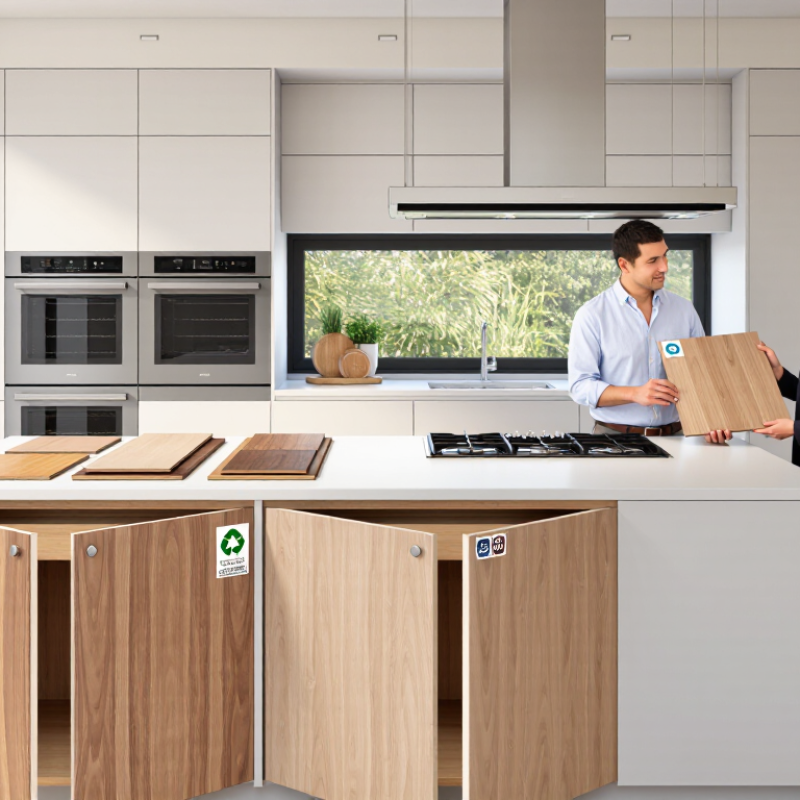
“Formaldehyde-free” plywood does not always mean that no formaldehyde can be detected. The phrase often describes the adhesive: a no-added-formaldehyde resin is used instead of a formaldehyde-based binder. Wood itself can release small amounts of naturally occurring formaldehyde. The label still leaves room for confusion.
Emissions testing offers a more useful comparison than a broad marketing phrase. Under U.S. EPA TSCA Title VI, hardwood plywood must meet an emissions limit of 0.05 parts per million. That is a regulatory ceiling, not proof of zero emissions. A compliant panel may use different adhesives, and its results depend on manufacturing and testing conditions. Ask for recent third-party test documentation that identifies the panel type and test method, rather than relying on a label alone.
For a kitchen cabinet, look beyond the front face. Check whether the core, backer, and edge components are covered by the same documentation. A cut edge can expose the layered construction, while a warm, newly installed room may make odors more noticeable. Odor is not a dependable formaldehyde test. WHO’s indoor-air guideline is 0.1 mg/m³ over 30 minutes, but room readings also reflect other sources and ventilation. “Formaldehyde-free” can be a helpful starting point, not a complete indoor-air guarantee.
“Formaldehyde-free” is not a single, universally defined emissions class. Check the adhesive declaration and the test or compliance documentation for the specific panel.
| Comparison point | Conventional plywood | Low-emitting compliant plywood | No-added-formaldehyde (NAF) plywood |
|---|---|---|---|
| What the description means | May use a formaldehyde-containing adhesive; the type of resin and finished-panel emissions vary. | Meets a specified emissions rule, such as applicable U.S. TSCA Title VI requirements. | Made with an adhesive formulated without intentionally added formaldehyde; this does not guarantee zero detectable emissions. |
| Useful emissions reference | Do not infer emissions from the word “plywood” alone; request test results or compliance documents. | For hardwood plywood, the U.S. TSCA Title VI limit is 0.05 ppm under the applicable test method. | NAF describes the adhesive formulation, not a universal numerical emissions limit. Ask for product-specific test data. |
| How to read the number | A measured result depends on the panel, conditioning, and test method. | The 0.05 ppm figure is a product-emissions compliance limit, not a recommended indoor-air concentration. | Compare results only when the test methods and units are comparable. |
| Potential cost impact | Often offers more choices, but price depends on grade, thickness, core, and finish. | Compliance alone does not determine price; compare equivalent grades and specifications. | May cost more, but there is no fixed premium. Adhesive, certification, availability, and order size affect quotations. |
| Documents to request | Product data sheet, intended-use information, and emissions test report where relevant. | TSCA Title VI compliance statement and required labeling or documentation for the product. | Written NAF adhesive declaration plus a recent emissions report identifying the test method and panel tested. |
| When the added cost may be worthwhile | May suit projects where documented low emissions are not a purchasing requirement. | A practical choice when verified regulatory compliance is the main requirement. | Consider it when avoiding intentionally added formaldehyde is a project priority and documentation supports the claim. |
Note: Emissions limits and certification requirements vary by jurisdiction and product category. The U.S. limit shown applies to hardwood plywood under TSCA Title VI; confirm the applicable rules for the destination market and intended use.
Not necessarily. The phrase often means the adhesive has no added formaldehyde. Wood can release small natural amounts. Zero is not guaranteed.
A limit of 0.05 parts per million applies to certain hardwood plywood products under a U.S. emissions standard. It is a ceiling, not proof of zero emissions.
Ask for recent third-party test results, the test method, and the exact panel type and thickness. Check that the paperwork covers the core, back, and edges. Details matter.
No. A strong smell is not a dependable formaldehyde test. A warm, newly fitted kitchen may make odors more noticeable, while ventilation and other materials affect room readings.
No. Veneer quality, core construction, bonding, and manufacturing control affect performance. Check that a sample door stays flat and a shelf holds its intended load.
It can reduce one source of indoor emissions, especially in a small room with limited ventilation. A room guideline of 0.1 mg/m³ over 30 minutes measures different conditions, so it is not directly comparable to a panel limit.
No. Wood sourcing, resin ingredients, transport, and lifespan also matter. A durable panel may avoid early replacement, though I may be underestimating how much installation affects that.
Face veneer, thickness consistency, core gaps, adhesive, sheet size, order volume, and freight can all change the quote. Damaged corners matter too. Compare matching specifications, not price alone.
Compare a delivered sample with the documented panel grade and construction. Inspect the cut edge for gaps and bonding. Paperwork can look convincing; I would still verify the batch.
Formaldehyde-free plywood is designed to reduce formaldehyde emissions, making it a considered option for homes, offices, and other indoor projects. Chinese plywood products may be evaluated through emissions testing and relevant certification, but buyers should check what each test measures and whether the documentation matches the specific product. Alongside potential indoor-air-quality benefits, performance depends on factors such as adhesive type, construction, surface finish, and intended use.
The cost can vary with materials, manufacturing processes, testing, certification, and supply requirements. Is formaldehyde-free plywood worth the extra cost? The answer depends on your project’s priorities, budget, and need for lower-emission materials. Compare specifications, request reliable test records, and assess durability and suitability for the planned application rather than relying on a label alone. This approach helps you weigh the upfront price against the product’s environmental attributes and long-term value.
