Avenue Decor Avenue Decor

China Best Soundproofing Acoustic Slats or Solid Wood?

Time:2026-10-15 Author:Ethan
0%

Choosing between acoustic slats and solid wood can change how a room sounds, feels, and performs. In China, both options are widely manufactured for homes, offices, studios, restaurants, and hospitality spaces. Yet their acoustic behavior is not interchangeable. Acoustic slat panels usually combine wood veneer, felt backing, and an absorptive cavity. They can soften reflections from walls, ceilings, and hard floors. Solid wood adds density, warmth, and visual strength. However, a thick timber wall does not automatically block voices or traffic noise.

Which is better for soundproofing: Acoustic slats or solid wood? The practical answer depends on the noise problem. Acoustic slats are often more effective for reducing echo inside a room. Solid wood can contribute to mass, but gaps, doors, joints, and thin construction may weaken its performance. True sound isolation requires a complete wall or ceiling system. It may include insulation, resilient channels, sealed edges, and tested assemblies.

On real projects, I have seen attractive timber finishes installed over weak walls. The room looked premium, but speech still passed through easily. That result is easy to misunderstand. Acoustic panels manage reverberation. They do not replace proper sound barriers. Product quality also varies, so buyers should request test data, fire classifications, moisture information, and installation guidance. ISO or ASTM reports can help, but only when the tested assembly matches the planned application. No material wins everywhere. Careful measurement matters more than a confident sales claim.
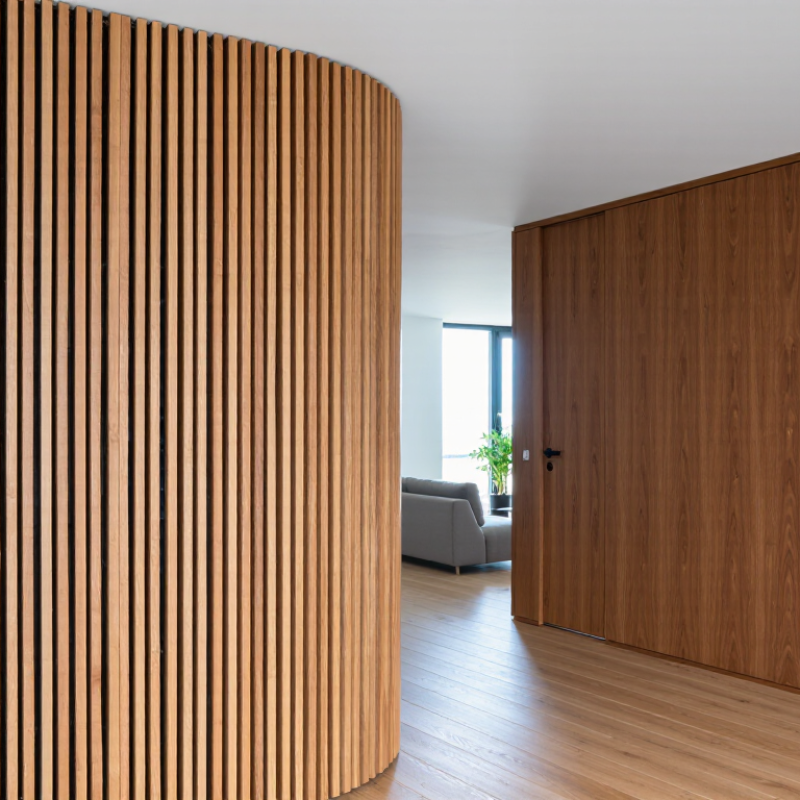
China Best Soundproofing Acoustic Slats or Solid Wood?

What Are Acoustic Slats and Solid Wood Soundproofing Panels?

Acoustic slats are decorative wall or ceiling systems designed to manage reflected sound. They usually contain narrow wood slats fixed over an acoustic felt or fiber backing. The gaps between slats expose the absorber behind them. This structure helps reduce echo, speech harshness, and reverberation in offices, studios, restaurants, and home theaters. It does not automatically stop sound from entering another room. That distinction matters.

Solid wood soundproofing panels are denser and more rigid. Their mass can help resist airborne sound transmission, especially when combined with sealed joints, resilient channels, and multiple wall layers. However, a solid wood panel alone may reflect sound rather than absorb it. Low-frequency noise can still pass through weak connections, doors, ceilings, or floor gaps. Heavy does not mean fully soundproof.

A practical acoustic assessment should measure the room’s reverberation, wall construction, and noise path. A slatted panel may improve clarity in a lively room. A solid wood layer may support sound isolation within a carefully engineered assembly. Installation quality is critical. Small gaps can reduce performance. I have seen attractive panels perform poorly when installers ignore corners and electrical openings. That mistake is easy to repeat. Check the backing material, panel density, fire rating, and tested acoustic data before choosing. Consider the actual problem: echo inside the room, or sound traveling through the wall?

How Do Acoustic Slats and Solid Wood Compare in Sound Control?

Acoustic slats and solid wood control sound in different ways. Acoustic slat panels usually combine timber strips with an absorbent backing. Their porous layer captures reflected sound, reducing echoes from walls and ceilings. Published ASTM C423 test summaries often show NRC values around 0.70–0.95 for well-designed slat systems. Results vary with spacing, backing, and installation depth.

Solid wood behaves differently. Its hard surface reflects much of the mid- and high-frequency sound. Thick wood can add mass, but it is not automatically a sound absorber. A thin timber wall may feel quiet while still producing noticeable speech reflections. The World Health Organization’s 2011 environmental noise report estimated over one million healthy life-years were lost annually in Western Europe because of traffic noise. That figure reminds us that surface treatment cannot solve every noise problem. Room layout and wall construction still matter.

Tips: Check the tested NRC, not only the product description. Ask for ASTM C423 results and installation details. For offices, restaurants, or music rooms, combine slats with soft flooring, curtains, or ceiling absorbers. Solid wood remains useful where durability and visual warmth matter. My practical concern is simple: attractive slats can underperform when installed over a hard, empty cavity. The comparison is not perfectly fair. Acoustics depends on the complete room, not one material.

China Best Soundproofing Acoustic Slats or Solid Wood? - How Do Acoustic Slats and Solid Wood Compare in Sound Control?
Comparison Dimension Acoustic Slats Solid Wood Practical Interpretation
Primary Sound-Control Function Primarily designed for sound absorption when installed with an absorptive backing such as mineral wool, glass wool, or acoustic PET felt. Primarily acts as a reflective and decorative surface. It may contribute some mass to a wall or door but is not normally an effective absorber by itself. Acoustic slats are generally better for reducing reverberation and improving speech clarity inside a room.
Typical Noise Reduction Coefficient (NRC) Approximately 0.60–0.95 for complete slatted systems with an absorptive backing and an appropriate air cavity. The exact value depends on the slat spacing, backing, thickness, and installation. Approximately 0.05–0.15 for smooth, sealed solid-wood surfaces tested as exposed finishes. Results vary with wood species, thickness, surface profile, and mounting. NRC is a laboratory absorption rating, not a direct measurement of sound isolation between rooms.
Sound Absorption High, especially across speech frequencies when the open area, backing material, and cavity depth are properly selected. Low when the surface is flat and sealed; the surface mainly reflects sound back into the room. Choose acoustic slats when the objective is to control echo, reverberation, or excessive room loudness.
Sound Transmission Reduction Slats alone provide limited sound isolation. Meaningful transmission reduction requires a tested wall, ceiling, door, or partition assembly with sealed joints and adequate mass. Solid wood can add mass and stiffness, but a single wood panel is rarely sufficient to provide high sound isolation. Assembly design and airtightness are critical. Neither product should be assigned an independent STC value without testing the complete construction.
Typical STC Consideration No reliable standalone STC rating. STC applies to a complete tested partition, not to decorative slats alone. No reliable standalone STC rating. A wood door, wall, or panel must be tested as a complete assembly, including seals and framing. Use tested assembly data under ASTM E90 or ISO 10140 when room-to-room sound isolation is required.
Speech Clarity Usually improves speech intelligibility by reducing reflected sound and reverberation. Can reduce speech clarity in reflective rooms because smooth wood surfaces return more sound energy. Acoustic slats are usually more suitable for meeting rooms, classrooms, offices, restaurants, and studios.
Low-Frequency Control Moderate and highly dependent on backing thickness, cavity depth, and the use of additional low-frequency absorbers. Limited as a flat, rigid finish. Greater low-frequency isolation requires a properly engineered high-mass, decoupled assembly. Neither material should be selected alone to solve strong bass transmission or vibration problems.
Installation Requirements Performance depends on correct spacing, continuous backing, cavity depth, edge treatment, and sealed perimeter details. Usually simpler as a finish layer, but gaps, joints, lightweight framing, and unsealed penetrations can significantly reduce acoustic performance. Installation quality can be as important as the visible finish material.
Air Gap Behind the Surface An air cavity commonly improves absorption, particularly when combined with porous backing. The optimum depth depends on the system and target frequencies. A sealed, rigid wood surface with a cavity behind it does not automatically become an effective absorber. The cavity should be designed as part of the tested or engineered acoustic system.
Fire and Safety Considerations Backing and slat components should have documented fire-performance classifications suitable for the project and local building code. Wood species, thickness, coatings, and treatment affect fire performance; untreated wood may require additional compliance review. Request project-specific fire test or classification documentation rather than relying on material appearance.
Moisture and Dimensional Stability Performance depends on the wood veneer, core, backing, adhesive, and environmental conditions. Interior humidity control is recommended. Solid wood can expand, contract, cup, or warp with changes in moisture content unless properly seasoned, detailed, and finished. For humid interiors, specify suitable materials, ventilation, and movement allowances.
Maintenance Requires regular dusting or vacuuming of the slat gaps and backing surface; damaged modules can often be replaced individually. Generally easy to dust and clean, but scratches, dents, and finish wear may be more visible on broad smooth surfaces. Maintenance requirements depend on the finish, access, traffic level, and room environment.
Aesthetic Flexibility Provides a linear architectural appearance while combining decorative slats with concealed acoustic treatment. Offers a natural, solid, and traditional appearance with a wide range of stains, textures, profiles, and joinery options. Acoustic slats prioritize integrated sound absorption; solid wood prioritizes material presence and visual solidity.
Relative Acoustic Value High for interior sound absorption when designed as a complete system. Low for exposed-surface absorption; potentially useful as one layer within a heavier, airtight sound-isolation assembly. For echo control, acoustic slats are normally the more appropriate choice. For sound isolation, evaluate the entire construction.
Best-Fit Applications Offices, conference rooms, classrooms, restaurants, hospitality spaces, auditoriums, home theaters, and other reverberant interiors. Doors, wall cladding, furniture, cabinetry, feature walls, and assemblies where appearance, durability, and natural material character are primary goals. The best solution may combine solid wood visible elements with concealed absorptive layers.
Data note: The NRC ranges shown are indicative ranges for commonly engineered interior systems, not guaranteed values for every product. Actual acoustic performance must be verified through laboratory testing or project-specific calculations. NRC is commonly measured under ASTM C423 or ISO 354, while sound transmission ratings such as STC require complete assembly testing under standards such as ASTM E90 or ISO 10140.

Which Materials and Structures Improve Acoustic Performance?

Acoustic slats and solid wood behave differently because structure controls how sound moves. Solid wood is dense and reflective, so it can make speech feel sharper in a bare room. It works better when perforated or installed with an absorbent backing. The surface alone rarely solves echo.

Slatted panels usually perform better when three parts work together: wood slats, open spacing, and a porous backing layer. Mineral wool or acoustic felt behind the slats absorbs sound entering the cavity. A deeper air gap can improve low and mid-frequency control. Narrower slat spacing may increase surface coverage, but excessive coverage can reduce absorption. Details matter.

In practical installations, room shape and mounting quality matter as much as the material. Loose joints, sealed edges, or a shallow cavity can weaken the expected result. Check tested absorption data, especially reverberation time and frequency ranges, rather than trusting a simple clap test. That test is useful, but limited. Solid wood may still be the better choice for visual warmth, durability, and controlled reflection in music rooms. Slats are not automatically superior. A common mistake is selecting panels before identifying the room’s main noise problem. For reliable decisions, compare thickness, density, spacing, backing, and installation depth under the same test conditions.

China Best Soundproofing: Acoustic Slats or Solid Wood?

Typical sound absorption coefficients by material structure and frequency

Acoustic performance depends more on the complete structure than on the wood surface alone. Solid wood panels generally provide limited sound absorption, while wood slats installed over an air gap with mineral wool or acoustic felt can absorb substantially more mid- and high-frequency sound. The values shown are representative absorption coefficients, α, commonly reported for comparable building-acoustic constructions; actual results vary with thickness, spacing, backing density, air cavity depth, installation, and test method. Higher values indicate stronger sound absorption, not necessarily better sound insulation between rooms.

How Does China Manufacture and Customize These Soundproofing Solutions?

China manufactures soundproofing acoustic slats through a controlled process that combines decorative woodwork with tested acoustic materials. Panels usually begin with responsibly sourced veneer, solid wood, or engineered boards. CNC equipment cuts regular grooves, while automated sanding improves surface consistency. Behind the slats, factories install recycled polyester felt or mineral-based acoustic backing. The air gaps help absorb reflected sound. Details matter.

Customization starts with room measurements, not only color selection. Manufacturers can adjust slat width, spacing, panel thickness, backing density, and edge profiles. They may also produce curved panels for ceilings or wraparound walls. For commercial interiors, production teams often prepare shop drawings, sample sections, and installation layouts before mass production. This reduces errors during fitting. It also exposes problems early.

Solid wood offers a warmer, more natural appearance and stronger tactile character. Acoustic slat panels usually provide more predictable sound absorption, especially across large wall areas. However, performance depends on the backing, cavity depth, and installation method. A decorative slat alone will not solve serious echo problems. That assumption needs correction. Buyers should request fire-performance documents, material specifications, moisture guidance, and acoustic test data from the manufacturer. Small sample approval is wise, because color, grain direction, and felt texture can differ from digital images. Some factories still rely heavily on manual finishing, so minor variation may remain. That is not always a defect, but it should be agreed before production.

Which Option Best Fits Different Rooms, Budgets, and Design Goals?

China Best Soundproofing Acoustic Slats or Solid Wood?

Room function should decide the material. Acoustic slats usually manage echoes, not sound transmission. Their felt backing and air gap absorb reflected speech, music, and footsteps. A tested Noise Reduction Coefficient, or NRC, helps compare performance. Under ASTM C423, an NRC of 0.70 indicates strong average sound absorption across tested frequencies. However, results change with spacing, backing, ceiling height, and installation quality. The neatest wall may still perform poorly.

Solid wood creates warmth, durability, and visual weight. Yet exposed wood mostly reflects sound. It can make a dining room feel lively, but may worsen flutter echoes in a meeting room or home studio. Real sound isolation needs mass, airtight joints, and decoupled construction. A thin timber panel will not stop television noise through a shared wall. That is an expensive misunderstanding.

For bedrooms, libraries, and small offices, combine slats with sealed doors, rugs, curtains, and dense wall assemblies. The World Health Organization’s Guidelines for Community Noise identify 30 dBA as a night-time bedroom target and 35 dBA for classrooms. These are demanding targets. Acoustic slats alone rarely achieve them. For restaurants or open-plan offices, slats can improve speech comfort without making the room visually heavy. Solid wood suits spaces prioritizing craftsmanship and reflection, especially when paired with ceiling absorbers. Budget planning should include substrate preparation and professional testing. I would question any product claiming universal “soundproofing” without an independent ASTM C423 or ISO 354 test.

FAQS

How are acoustic slat panels manufactured?

Factories usually start with veneer, solid wood, or engineered boards. CNC machines cut consistent grooves. Automated sanding improves surface smoothness. Recycled polyester felt or mineral-based backing sits behind the slats. Small details matter.

What can be customized for a specific room?

Manufacturers can adjust slat width, spacing, thickness, backing density, and edge shape. Curved panels may suit ceilings or wraparound walls. Room measurements should guide customization. Color alone is not enough.

Do acoustic slats completely soundproof a room?

No. They mainly reduce echoes and reflected sound. They do not usually stop television noise through a shared wall. True isolation needs mass, airtight joints, and separated construction. This distinction is easy to miss.

How do acoustic slats compare with solid wood?

Acoustic slats usually provide more predictable absorption across large wall areas. Solid wood offers warmth, durability, and stronger visual character. Exposed wood mostly reflects sound. That can make a dining room lively, but worsen echoes elsewhere.

Which rooms benefit most from acoustic slats?

Restaurants, meeting rooms, open offices, libraries, and home studios can benefit. Slats may make speech clearer and reduce harsh reflections. Bedrooms may need sealed doors, rugs, curtains, and denser wall assemblies too. One wall rarely solves everything.

What affects acoustic performance after manufacturing?

Backing density, air gaps, cavity depth, room height, spacing, and installation quality all matter. A beautiful panel can still perform poorly. The neatest wall is not always the quietest wall.

What documents should buyers request?

Ask for material specifications, fire-performance documents, moisture guidance, and acoustic test results. Independent absorption testing is useful. A claimed performance number without testing deserves questions. I would stay cautious here.

Why should buyers approve a physical sample?

Digital images may hide differences in color, grain direction, and felt texture. A sample shows the actual surface under room lighting. Manual finishing can leave minor variations. That is not always a defect, but expectations should be agreed early.

Conclusion

Acoustic slats and solid wood soundproofing panels offer different approaches to improving interior sound quality. Acoustic slats typically combine decorative wood strips with an absorbent backing, helping reduce echo, reverberation, and reflected noise while adding visual warmth. Solid wood panels provide strength, natural beauty, and some sound diffusion, but their performance depends heavily on thickness, surface design, spacing, and installation. Which is better for soundproofing: Acoustic slats or solid wood? In most rooms, acoustic slats are more effective for controlling reflections because their layered structure can include mineral fiber, felt, perforations, or an air cavity.

The best choice depends on the room, budget, and design goals. Offices, studios, restaurants, and home theaters often benefit from customized acoustic slat systems with carefully selected cores and panel spacing. Solid wood may be preferable for premium interiors, feature walls, or areas where durability and a traditional appearance matter most. China’s manufacturing capabilities support flexible sizes, wood finishes, core materials, fire-performance requirements, and installation methods, allowing both solutions to be tailored for practical acoustic and aesthetic needs.

Ethan

Ethan

Ethan is a seasoned marketing professional with a deep expertise in our company's innovative product line. With a passion for sharing knowledge and insights, he takes the lead in regularly updating our corporate blog, where he explores industry trends, product features, and effective marketing......