 Avenue Decor
How long should WPC outdoor wall cladding last? The honest answer depends on the board, installation, exposure, and maintenance. What is the lifespan of WPC outdoor wall cladding? There is no single service-life figure that applies to every product or building.
ASTM International’s D7032 standard provides a useful performance-testing reference for wood-plastic composite deck boards and guardrails. It is not a lifespan guarantee for wall cladding, but it highlights why testing and product specifications matter. The USDA Forest Products Laboratory’s Wood Handbook also explains how moisture and sunlight affect wood materials. WPC is different, yet these exposure factors still help explain why shaded, well-drained walls may age differently from sun-baked, rain-exposed façades.
Look beyond a headline number. Check the manufacturer’s technical data, warranty exclusions, installation guidance, and test results for weathering, water absorption, and dimensional stability. A north-facing wall beneath a deep roof overhang is not the same as a west-facing wall with strong afternoon sun and wind-driven rain. Small details matter: sealed cuts, expansion gaps, and clear drainage paths can influence performance. Not glamorous, but important.
A warranty is not a measured service life. And a few years of product history may not reveal how boards will look after decades outdoors. This guide examines realistic lifespan expectations, the conditions that shorten or extend service, and the evidence buyers should request before choosing WPC cladding.
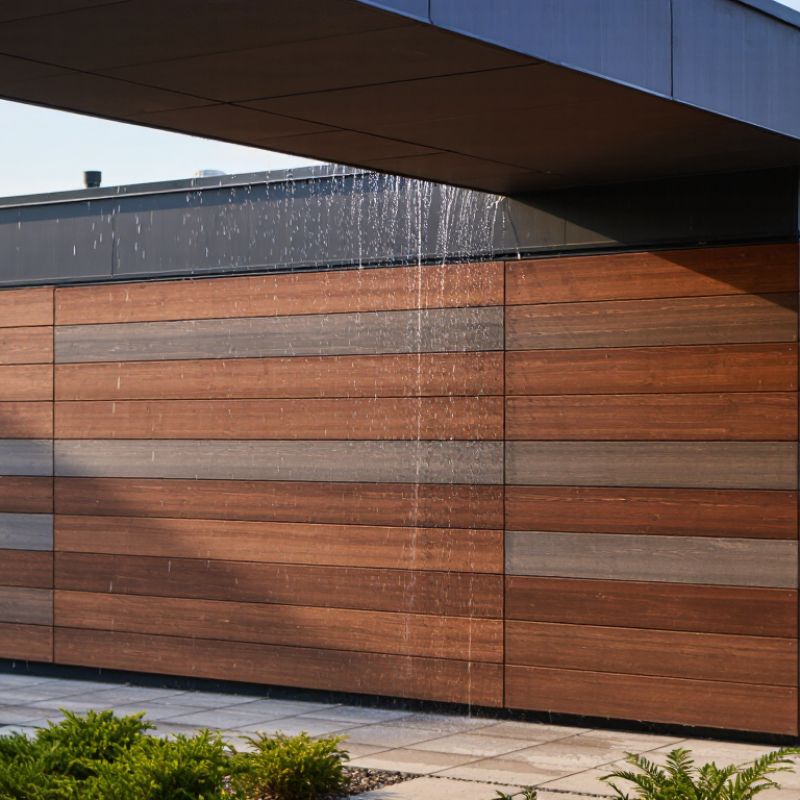
2026 Top WPC Outdoor Wall Cladding Lifespan?
What WPC Wall-Cladding Lifespan Means: Service Life Versus Warranty
A warranty and a product’s service life describe different things. They differ. A warranty sets out the period and conditions under which the supplier may repair or replace a defective product. Service life is how long the cladding remains useful in its actual setting. It depends on exposure, installation, drainage, and care—not just the date printed on a document. Check what the warranty excludes, including damage linked to poor installation or inadequate maintenance.
For a realistic estimate, consider the wall itself. A shaded, well-ventilated façade with clear drainage faces different demands from a south-facing wall exposed to strong sun and driving rain. Look closely at joints, cut edges, fixings, and the clearance above paving. Trapped moisture can leave marks or stress components over time. Rinse away dirt when needed, and inspect for loose boards after severe weather. Small checks matter.
No single lifespan figure suits every building. Ask for test information and care instructions for the specific cladding system, then compare them with your site conditions. A long warranty may sound reassuring, but it is not a guarantee that the wall will look new for that entire period. Wear happens. Even careful planning can miss a detail. Revisit the installation after the first wet season.
| Comparison Dimension | Service Life | Warranty Period | What to Check |
|---|---|---|---|
| Meaning | The period the installed cladding remains usable and performs acceptably under its actual conditions. | The period during which specified defects may qualify for a remedy under the written warranty terms. | Do not treat the warranty end date as a prediction of when the cladding will fail. |
| Typical time frame | A planning estimate may be around 20–30 years for suitable products that are correctly installed and maintained; actual results can be shorter or longer. | There is no universal term. Coverage and duration are product- and jurisdiction-specific; check the current written warranty. | Compare the exact product, application, covered defects, exclusions, and remedy—not just the headline number of years. |
| What the figure describes | Real-world performance, including appearance, structural condition, and continued suitability for use. | Contractual coverage for defined issues, such as certain manufacturing defects, subject to stated conditions. | A warranty may cover only particular defects and may not cover normal weathering, wear, or damage caused by installation or use. |
| Climate and exposure | Strong sunlight, heat, freeze–thaw cycles, moisture, salt, and poor drainage can affect long-term performance. | Environmental exclusions or limits may apply, depending on the written terms. | Confirm that the product is intended for the local climate and the specific exposure, including coastal or high-UV conditions. |
| Installation | Correct support spacing, ventilation, drainage, clearances, and fasteners help the system perform as intended. | Non-compliant installation may limit or invalidate coverage where the warranty requires specified installation methods. | Follow the product’s installation instructions and applicable building requirements; keep installation records. |
| Maintenance | Periodic cleaning and prompt attention to drainage or fixings can help preserve appearance and function. | Some warranties require reasonable care or documented maintenance. | Use the cleaning methods recommended for the product; avoid assuming that all WPC formulations have identical care needs. |
| How to compare products | Ask for relevant test data, intended-use information, and evidence from comparable exposure conditions. | Read the full warranty for its start date, duration, covered components, claim process, exclusions, and remedy. | Evaluate service-life evidence and warranty terms separately, alongside installation requirements and total lifecycle cost. |
Note: The service-life range above is a broad planning estimate, not a guarantee or a prediction for any specific installation. Actual performance depends on product formulation, design, exposure, installation quality, maintenance, and local conditions. A warranty is a written coverage commitment, not the same thing as expected service life.
It assesses water absorption, dimensional change, and flexural behavior. These results help compare materials under defined conditions, but do not promise a specific lifespan.
It uses filtered xenon-arc light to simulate parts of sunlight and weathering. Reports should describe exposure time, temperature, and moisture cycles.
Not reliably. Sunlight, drainage, shade, installation, and local climate all affect aging. The gap between lab and site conditions matters.
Ask about swelling, surface cracks, color change, and retained flexural strength. A simple “passed” statement gives little detail.
A south-facing wall may fade faster than a shaded one. Poor drainage can leave board edges damp. Small details matter.
Photograph the same areas every six to twelve months. Check for color shifts, loose fixings, cracks, swelling, or water near joints.
Review the coverage period, installation requirements, maintenance duties, and exclusions for fading or moisture damage. A long warranty does not mean the wall will look new throughout.
Record its location and date, then ask a qualified installer to assess the cause. Concealed moisture or installation faults may be easy to miss.
What is the lifespan of WPC outdoor wall cladding? There is no single answer: actual service life depends on the product’s wood-fiber and polymer composition, manufacturing quality, climate, and maintenance. Service life describes how long the cladding remains functional, while a warranty is a set period of coverage with specific conditions; the two are not necessarily the same. A higher resistance to moisture and weathering can support durability, but performance should be assessed using relevant test methods, including EN 15534-1 and ISO 4892-2, which address material properties and accelerated weathering.
Installation and ongoing care also matter. Poor drainage, inadequate expansion gaps, or unsuitable fasteners can contribute to water retention, movement, and premature damage. To estimate likely service life, consider the site’s sun, rain, temperature, and exposure conditions, review applicable warranty terms, and inspect the cladding regularly for discoloration, loosened fixings, or other changes. Good installation and timely maintenance can help the system perform as intended.
